Tuesday, April 28, 2009

Contemporary Designers Presentation

Contemporary Fashion in MoscowMoscow has recently caught the attention of the fashion industry as an emerging centre, thanks to a number of young designers who have created a sensation throughout Europe. Moscow's place as Russia's fashion capital is relatively new, with 2006 marking the successful first year of Russian Fashion Week (RFW), held in Moscow. It showcased a variety of Russian and international designers, who all appeal to the new Russian fashion consumer.

Inspiration/ Influences:
Russian fashion has a strong historical influence. Many designers use traditional elements of dress and re-interperate them in a modern context. The cold Russian weather is another clear influence on fashion, with furs and large coats never going out of style. 

Influence on Other Designers:
Moscow recently had a notable influence on Karl Lagerfeld. He presented the Chanel Pre-fall 2009 show there. The designs were reflective of a traditional Russian aesthetic. 
Design schools:
There are no fashion design specific schools in Russia. Most emerging designers got their qualifications in France or Italy, with many also gaining work experience with major fashion houses. 

Industry:
The Russian fashion industry, in terms of production, is very small. Most designers have garments made in either Eastern Europe or China. The manufacturing industry in Moscow has a very specific focus on the production of traditional garments and furs. 

Market/ Consumer behaviour:
The luxury sector is a major market in Russia. Many fashion houses from the luxury sector (such as Chanel, Dior, Balenciaga, Gucci, Prada and Versace) setting up shop in Moscow to great success. 

Emerging designs:
More photos here

More photos here

Saturday, April 4, 2009

TCF

SWOT Analysis of My Personal Design Practice

Strengths:
*Innovation.
*Adaptable to changing consumer behaviour.
*Adaptable to the changing luxury fashion industry.
*Keen to utilise on-shore production and local industry to produce a globally viable product. 

Weaknesses:
*Lack of contacts/ knowledge of the industry.
*Finance.
*Limited access to and high costs of on-shore production.

Opportunities:
*Changing consumer behaviour.
*The economic collapse (based on past post-recession consumer behaviour and attitudes)
*Global networking. 

Threats:
*The economic collapse.
*Local and global competitors.
*Future uncertainty regarding the economy, consumer behaviour and trends.

Friday, March 27, 2009

New Fashion Centres

Australian Fashion
Globally, Australia is often overlooked as a fashion centre. But with global changes occurring at every level of the industry, are things about to change?

So, what are the big 'things' affecting fashion? And how do they affect Australian fashion?
The Economy: By now we are all well aware of the economic collapse that took hold of the world at the end of last year. The effects of 'recession' are being felt in all industries, especially fashion. However, Australia is in one of the best positions it could be, because for the most part it is sheltered from great economic upheaval, which means our industries (e.g. Fashion) will bounce back quicker, and better than before.
Global Networking: Social networking and ease of global communication have opened up a multitude of opportunities for Australian fashion designers. We can be influenced by global trends in consumer behaviour and trends at a far superior level. 
Other New Fashion Centres: Australia is surrounded by other emerging fashion centres. China, Japan, India and New Zealand are all having a great influence on global fashion and prove there is a growing popularity in Australasian fashion and lifestyle.
New vs. Old: Past post-recession consumer behaviour tells us that new design is adopted far quicker than traditional. Australia as a new fashion centre will have the opportunity to take advantage of this consumer behaviour and potentially play a big role in the development of the contemporary industry.

I think Australia is in a perfect position to become a global fashion capital. As the designers of the future, what do you think?

Friday, March 20, 2009

Fast Fashion and Sustainability

Changing Contemporary Consumer Behavior
Fashion has always changed and moved with the times. So it was no surprise when during the '90s fast fashion started dominating the industry. It was a reflection of fast paced lifestyle driven by strengthening economy and faster methods of communication. Post-millennium, fast fashion boomed and the age of the cheap, throw-away garment was born. All of a sudden trend movement was condensed from 12 months to less than 12 weeks. Consumers loved it and they still do. Finally fashion was providing for the 'I want it right know' demands of modern society, but at what cost?

Fast fashion and sustainability. Is it possible to have both? Perhaps it is, but many things about the current state of the industry need to change first. Primarily consumer behavior. There are a number of global factors that effect consumer behavior:
* Fast paced lifestyles: We are doing more than ever before. We find ourselves responsible for what feels like a million things at home, work and in our social lives. Time is of the essence; things need to be done quicker and more efficiently. We want what we want RIGHT NOW - there is simply no time to wait. 
* Economy: The economy during the late '90s was strengthening . Consumers had more money to spend, and spend we did. Topshop's annual turnover increased to $500-million in a matter of years. Even now with the economic collapse, consumers are turning to fast fashion. We have developed a mentality of 'Why would you buy one designer garment, when you can buy 5 equally trendy garments for the same price at a fast fashion chain?'
* Communication: Fashion trends are communicated to consumers quicker than ever. Within a few hours of fashion shows debuting in cities such as Paris and New York, pictures of the entire show are up on websites such as style.com and coutorture.com. Press of the shows builds and soon there is an overwhelming desire for particular items, so fast fashion provides, sometimes 6 months before the designers can get the item into their own boutiques.

Obviously it will take a lot of time for this consumer behavior to change. The sustainability of the fashion industry is vitally important for continued growth and improvement. I believe that the following are key to changing the contemporary consumers behavior:
* Education: There are a number of designers and fashion business's offering a sustainable alternative, but most consumers are unaware of this or are simply ignorant about the importance of sustainability.
* Transparency of design practice: Most consumers are unaware about the practices used by most fast fashion chains. Practices such as sweatshops, environmentally damaging fabrics, and cross-continental shipping of garments should be divulged to consumers so that they can make an informed decision. 
* Aesthetics: In the end fashion comes down to people wanting to look good. If someone has the choice between two garments of the same price, one boring (albeit sustainable) and the other aesthetically pleasing then the choice will most likely be for the pretty one. This consumer behavior isn't going to change, so instead the design of sustainable fashion needs to. 

Consumer behavior regarding fashion has to change, there is no doubt about that. The how and the when comes down to us.

Saturday, March 14, 2009

Menswear

Modern Menswear: Breaking the Mould
Menswear has spent the last century caught in a dull cycle of boring styles, but that may be about to change. During the past year there has been a shakeup in mens style; a slow, small, but determined movement towards interesting, innovative clothing for the modern man. Because after all, why should men miss out on the fun in fashion? Here I look at some examples of the potential future of menswear:

* Colour: Winter colour palettes usually consist of dark hues, especially in menswear, but not this year. Hermes explored bright colour in their recent Autumn 2009 collection.

* Shape: Designers such as Gareth Pugh and Dior Homme explored sculptural elements in their recent ready-to-wear collections. 

* Pattern: Moschino recently experimented with patterned fabrics in their menswear. 

* Texture: Textural elements such as quilting were recently used by Junya Watanabe for Autumn 2009.

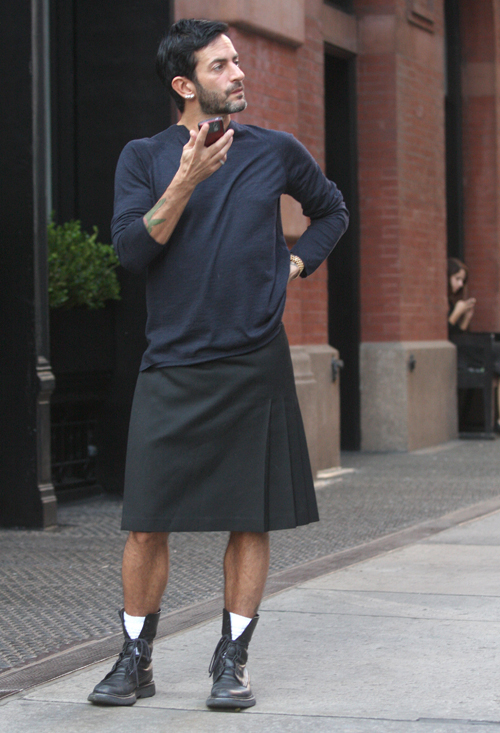
* Men in dresses: Yes you're reading that right, and why shouldn't the dress be adapted to menswear. American fashion designer, Marc Jacobs sure likes skirts, having been seen in them for quite some time now. And photographer, Kah Poon certainly likes the idea of men in dresses and ruffles.

So do you think this is the future of mens fashion??

Gender and Sexuality

Tortured Femininity - The Corset in the 21st Century

As we look at the role of gender in fashion we begin drawing parallels between certain styles of dress and divide the others into 'Feminine' and 'Masculine'. A classic example of this is the corset. Stereotypically it is seen as a 'Feminine' piece of clothing worn to cinch in the waist and exaggerate womanly curves. But what is the place of the corset in the 21st century?

The corset has a very long and controversial place in history. The modern corset was originally designed in the mid 1500's to restrict the movement of women. It underwent many changes in the centuries to follow, but one thing remained clear; the corseted figure had become the 'ideal' figure.

The history of the corset has shaped so much of what we know it to be today. It is still seen as an 'ideal' figure. Even a type of beauty. But now more than ever it is about extremes. How far can you take it? The record for the smallest waist on a living person is a mere 38.1cm. Extreme corseting is now considered a subculture, also known as Tight-lacing. It is practiced by both men and women. One of the most well know male Tight-lacers is corset-maker, Mr. Pearl. The practice of Tight-lacing is not restricted by gender, nor is it seen as some sort of 'feminine' practice or ideal beauty. It is a form of body manipulation (or some would say mutilation) far removed from the realm of fashion and its historical context. 

Subcultures and Individualism

Interview with an Emo
One only has to take a quick walk through Canberra's city centre to see the prominence of the Emo subculture. People assume a lot about it and the people who associate themselves with it. But what does a member of this group have to say? I asked my friend some questions about subculture and individualism so to clear up any misguided assumptions.

Tell me a little about yourself... I'm 23, studying fine arts at university, I work part time and I'm an Emo.

What do you think defines an individual? Someone who isn't afraid of standing out or expressing their personal beliefs. I'm an individual.

So you think you express a certain sense of individualism? Well yeah. I'm not like every other preppy kid or public servant here in Canberra, am I? You look at the kids walking through Civic and they're all the same. They wear the same shoes, the same shirts and listen to the same music; they think they're so cool because they're just like everyone else. I don't relate to that sheep-like mentality at all.

How did you get involved in the Emo culture? It was the music. I really connected to the Indie Rock/ Emo genre when I was in high school. I found a group of people at my school that were into it too and I guess we just clicked over it. Everyone at high school and college thought we were so weird, I guess because we didn't dress or behave like them. For the most part we felt alone. It wasn't until we started to go to Melbourne and Sydney to gigs that we realised we weren't alone.

What about it drew you in? It was like the music was speaking to me. The themes were so relevant to my life at the time. And I admired the bands because the weren't afraid of being themselves. As for the people in the culture, it was like finding long lost family. I could relate to them, they didn't think I was some freak with too much to say.

What would you say to people who think that someone in a subculture is no more individual that a person living a 'mainstream' existence? I'd say they're pretty ignorant and obviously live in some sort of bubble.

But you agree that the mainstream image of a subculture often hides what it is to be an individual in that group? Yeah definitely. I've watched this culture change so much during the past few years. It has become so mainstream that the true meaning behind it has been watered down to an unrecognisable state. I feel like I'm an individual because I'm one of the originals. I'm not like one of those 15-year-old brats that sit in Garema Place moping about how hard life is. If you ask those kids about what it is to be Emo, they'd probably tell you a bunch of stories about how cool they think they are because they cut up their bodies and get really wasted. And sure people might confuse me with one of those kids because I wear black, have a fringe and like tight jeans. People are dumb. They take everything on face value alone and don't bother questioning the deeper meaning.

So you agree that you have a bit of a mainstream image going on? Yeah. but only because popular culture stole my image and pimped it out to all the unoriginal kiddies out there. My image is not about looking cool; it's an expression of my personality.

What do you consider your individual place in this subculture to be? Well first of all I'm an edgeways Emo, which means I made an agreement to stay away from drugs and alcohol. I believe in God. I don't self mutilate in the form of cutting and burning, I do however have 9 piercings and 3 tattoos. I love the music, particularly the underground sounds coming from Melbourne at the moment. I wear black because I like it, not because I think it looks cool. I don't sit around moping about the state of the world; I get up and say or do something about it.

Is subculture for life? Hell yes. If it's not then you're in it for the wrong reasons. I have 'Until The Grave' tattooed on my back because that's how I feel about the way I choose to live my life. Subcultures aren't trends, they're lifestyles. Never forget that.

Luxury, Consumption and Ethics

The Future of Luxury Fashion in Today's Economic Climate

Luxury is defined as anything that pleases the senses, and is also costly or difficult to obtain; an expensive rarity; as silks and jewels are luxuries. Any convenience regarded as an indulgence rather than a necessity.
Luxury fashion is just that. It is an indulgence, and expensive rarity, it is something that pleases the senses and is quite costly. It is exclusive and highly sought after.

At the turn of the century luxury fashion was redefined. it was no longer exclusively available to the rich and famous. the production of luxury goods rose by 200% and there was a 60% increase in small/ suburban luxury good outlets. Why? Because the economy was in the best position it had been in for nearly 2 decades. People had money and they weren't afraid to spend it. Luxury fashion entered the middle market; but it would soon pay the price.

The image of luxury fashion has become tarnished by over-production and greed. For centuries luxury fashion was set apart from the mainstream by quality and exclusivity. Products were custom designed and hand-made by artisans in Paris and Milan. In recent years it has been churned out at a frenetic pace because demand has grown quite significantly. 

But what happens when a company used to producing 2000 units of an item all of a sudden has a demand for 20,000? Some such as Hermes use it to reinforce their exclusivity by turning less desirable customers away and establishing waiting lists for items. Most on the other hand see dollar signs in their eyes and make the production possible. Take Louis Vuitton for example. In 2000-1 there was an overwhelming demand for their monogrammed handbags and small accessories, so for the first time in the companies history they used machines to make them. Now Louis Vuitton are being accused of sending the production of popular small accessories such as wallets and coin-purses to China. It raises the question: can a product that is produced in sweetshop conditions, regardless of the label, still be considered luxury?

Thankfully I believe this practice will be stopped, not because of the ethics, but because of the economy. What happens to luxury fashion now that people have lost much of their disposable income? It has to revert back to the tried and true methods that made it so sought after in the beginning. The following will be key:
1- Classic simplicity: consumers will look for investment pieces; accessories and garments that will have a long wear life. 
2- Quality and Exclusivity: if they are paying higher prices, consumers will want their products to stand the test of time and be something that is custom designed to meet their needs.
3- Discretion: some consumers with vast amounts of money will not wish to advertise the fact. Logos and monograms will become smaller.

Luxury fashion will never cease to exist. However, it will change to suit the times, whatever they may be.